Trusts are created as structures to preserve financial wealth, provide continuity, and protect future generations. But structure alone does not sustain a legacy or ensure intended outcomes. The connection between the values that shaped the wealth creation and financial decisions
Anchoring to values is an important part of building a framework to navigate family wealth. Breaking the components down into three guiding pillars: Purpose, Principles, and Path.
Purpose: Defines the “why” or the family value system and provides context for what financial wealth is intended to promote.
Principles: Define how financial decisions are made and how they align with the family value system
Path brings the framework into motion. It reflects the intentional steps a family takes to build continuity, prepare rising generations, and carry their values forward in a meaningful way.
This article focuses on that second pillar of Principles. Because even the most carefully drafted trust can create uncertainty if beneficiaries do not understand the principles guiding its administration.
From Family Values to Financial Decisions
Principles don’t live only in estate documents. They show up in the everyday financial choices families make, long before a trust is even part of the conversation.
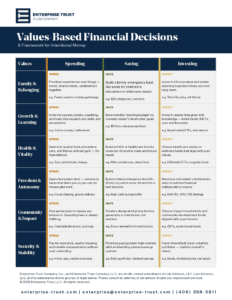
Our Values-Based Financial Decisions framework is a practical starting point for that work. It maps six core values: Family & Belonging, Growth & Learning, Health & Vitality, Freedom & Autonomy, Community & Impact, and Security & Stability, to concrete behaviors across spending, saving, and investing. When families work through this tool together, they begin to surface the principles that already guide their financial lives, often without having named them explicitly.
This is where the real clarity begins. When a family can say, in clear terms, what they value and how those values show up in financial choices, those principles carry forward into everything that follows, including how a trust is structured, how distributions are evaluated, and how wealth is understood across generations.
Principles Create Alignment and Structure
Families often assume that once a trust is established, clarity will naturally follow. In practice, clarity comes from understanding how the decisions that are made reflect shared values.
It’s important to address questions such as:
- What does responsibility look like in this family?
- How do we balance opportunity with accountability?
- How do we support individual growth while protecting long-term sustainability?
When these principles are articulated and consistently applied, trust decisions feel intentional. Beneficiaries may not always agree with every outcome, but they can understand the values that lead to the decision.
Communication Bridges Values and Action
Many challenges in trust administration stem from assumptions, or inconsistent communication. Beneficiaries who do not understand how decisions are evaluated can fill the gaps with their own interpretations. Over time, uncertainty can turn into frustration, causing unnecessary distance within families..
Clear communication does not require constant explanation or overexposure to technical detail. It requires consistency, communication, and context.
Promoting Stewardship Across Generations
When Purpose and Principles are aligned, the trust serves more than a financial function. It becomes a tool to support the Path of the family, and promote thriving family members and reflect expression of stewardship.
As life unfolds, families benefit from revisiting and reinforcing how their values show up in trust administration. A thoughtful trustee, working alongside advisors and family members, ensures that decisions continue to reflect the family’s foundational beliefs while adapting responsibly to new realities. In this way, trust administration becomes an expression of stewardship, not just compliance.
The Role of a Corporate Trustee in Preserving Principles
A corporate trustee plays an important role, as an administrator of assets, and as a consistent steward of the family’s articulated principles.
As an independent fiduciary, a corporate trustee approaches decisions through documented processes, while upholding fiduciary standards. The fact that a corporate trustee is outside the family dynamics allows for an independence that protects both the trust and the relationships surrounding it. When a family member is placed in the role of decision-maker, personal dynamics can complicate financial judgment. A corporate trustee removes that potential for misinterpretation and skewed family dynamics.
Why Choose Enterprise Trust
At Enterprise Trust, we approach trust administration through the lens of your Family Blueprint. Purpose defines the intent. Principles guide the decisions. Path brings structure to execution.
As an independent corporate trustee, we provide disciplined administration and steady communication anchored in your family’s values. Our role is not simply to manage assets, but to uphold the standards that give those assets meaning, protecting both the wealth and the relationships it was designed to support.
Enterprise Trust & Company, Inc., and Enterprise Trust Company, LLC, are wholly-owned subsidiaries of Lido Advisors, LLC. Lido Advisors, LLC, and its subsidiaries do not give tax or legal advice. Please consult an attorney or tax advisor should you require such services.